
Generative AI adoption has skyrocketed, with over 80% of companies deploying these applications by 2026. This technology reshapes how blockchain and gaming industries create content, automate processes, and deliver value. You’ll discover how generative AI works, its practical applications in smart contracts and game development, and why it matters for your investment decisions in these rapidly evolving sectors.
Table of Contents
- Introduction To Generative AI
- How Generative AI Works: Models And Processes
- Applications Of Generative AI In Blockchain
- Applications Of Generative AI In Gaming
- Common Misconceptions About Generative AI
- Comparing Generative AI Models And Trends
- Emerging Trends And Future Outlook For Generative AI In 2026
Key takeaways
| Point | Details |
|---|---|
| Core mechanism | Generative AI creates original content using deep learning models trained on massive datasets. |
| Training process | Development involves three phases: foundation training, domain tuning, and iterative generation. |
| Blockchain applications | Powers smart contract automation, NFT creation, and decentralized finance tools. |
| Gaming innovation | Enables dynamic environments, procedural content, and AI-driven NPCs while reducing costs. |
| Future trends | Domain-specific models and agentic AI dominate, with $30-$40 billion projected revenue. |
Introduction to generative AI
Generative AI represents a breakthrough in artificial intelligence that autonomously produces original content across multiple formats. Unlike traditional AI systems that classify or predict, generative AI uses deep learning to create entirely new text, images, code, and videos by learning patterns from vast datasets.
The technology’s relevance extends far beyond simple automation. Over 80% of organizations worldwide expect to integrate generative AI applications into their operations by 2026, recognizing its potential to transform business processes fundamentally.
For blockchain and gaming industries specifically, generative AI offers unprecedented opportunities to innovate:
- Automate complex smart contract development and testing
- Generate unique digital assets for NFT marketplaces
- Create dynamic game content that adapts to player behavior
- Reduce production costs while scaling creative output
Understanding these foundational generative AI concepts positions you to identify investment opportunities and assess emerging projects in cryptocurrency and gaming sectors. The technology’s ability to learn patterns and generate novel outputs makes it particularly valuable for industries built on digital creativity and automated trust systems.
This foundation sets the stage for exploring how generative AI actually produces content and why its applications matter for your portfolio decisions.
How generative AI works: models and processes
Generative AI operates through a structured development process that transforms raw data into creative output capabilities. Training involves three distinct phases that build increasingly specialized knowledge.
The foundation phase establishes baseline capabilities:
-
Foundation model training: Large language models like GPT or image generators like DALL-E consume billions of data points from diverse sources. This massive scale enables the model to understand general patterns in language, visual composition, or code structure. Training can take weeks or months on specialized hardware.
-
Domain-specific tuning: Generic models get refined with targeted datasets relevant to specific industries or tasks. A model trained on general text receives additional training on legal documents, medical records, or blockchain protocols. This technical deep dive on generative AI models reveals how tuning dramatically improves accuracy for specialized applications.
-
Iterative generation and evaluation: The model produces output, receives feedback on quality and accuracy, then adjusts internal parameters. This cycle repeats thousands of times, progressively improving results. Human reviewers often provide critical feedback that automated metrics miss.
Different model architectures excel at different content types. Transformer models dominate text generation, while diffusion models lead in image creation. Some systems combine multiple architectures to handle varied output formats.
The training and tuning phases overview demonstrates why careful data selection matters enormously. Models inherit biases and limitations from their training data, making quality control essential at every stage.
Understanding this technical foundation helps you evaluate claims about AI capabilities in blockchain projects. When a gaming platform promises AI-generated content, you can assess whether they have the data, computing resources, and expertise to deliver. These generative AI training details separate genuine innovation from marketing hype.
Applications of generative AI in blockchain
Blockchain technology gains substantial capabilities when integrated with generative AI systems. Applications include smart contract automation and novel digital asset creation that reshape how decentralized systems operate.

Smart contract development accelerates dramatically with AI assistance. Developers describe desired functionality in natural language, and generative models produce initial code implementations. This reduces development time from weeks to hours while minimizing common security vulnerabilities. The AI identifies potential exploits based on patterns learned from thousands of audited contracts.
NFT creation reaches new creative heights through generative algorithms:
- AI systems generate unique artwork variations following specified style parameters
- Text-to-image models create custom NFT collections at scale
- Generative music AI produces original soundtracks for digital collectibles
- 3D model generators create metaverse assets with distinct characteristics
Decentralized finance platforms leverage AI agents for sophisticated trading strategies and risk assessment. These agents analyze market conditions, execute complex multi-step transactions, and adapt strategies based on real-time data. The automation removes human emotional bias while operating 24/7 across global markets.
Over one-third of blockchain projects now integrate generative AI capabilities by 2026, according to blockchain AI analysis. This integration drives new business models where AI-generated content becomes tradable assets or where smart contracts self-optimize based on usage patterns.
The combination creates investment opportunities in platforms offering generative AI in blockchain infrastructure. Projects that successfully merge these technologies gain competitive advantages in scalability, user experience, and operational efficiency. Watch for platforms with proven AI integration rather than those simply promising future implementation.
Applications of generative AI in gaming
Gaming experiences transform when developers harness generative AI for content creation and player interaction. Generative AI revolutionizes game environments through dynamic systems that adapt to individual players.
Procedural content generation scales beyond traditional methods. AI systems create entire game worlds with unique geography, architecture, and ecosystems. Each playthrough offers fresh experiences as the AI generates new quest lines, character dialogues, and environmental puzzles based on player behavior patterns.
Non-player character (NPC) behavior reaches unprecedented sophistication:
- NPCs generate contextually appropriate dialogue in real time
- Character personalities evolve based on player interactions
- AI-driven NPCs remember past encounters and reference them naturally
- Enemy AI adapts combat strategies to counter player tactics
Video production costs plummet with generative AI tools. Cutscenes that traditionally required motion capture studios and weeks of rendering now generate in hours. The technology analyzes script requirements and produces cinematics matching the game’s visual style, reducing production budgets by 60-70% for indie developers.
These innovations democratize game development. Small studios access capabilities previously exclusive to major publishers, fostering creativity and competition. The game AI market insights show investment flowing toward platforms enabling this new generation of AI-powered games.
Blockchain gaming particularly benefits from generative AI. Play-to-earn games create unique in-game items as NFTs, each with distinct AI-generated attributes. This scarcity-through-uniqueness model drives secondary market value while maintaining fresh gameplay.
Investors evaluating gaming projects should assess whether studios demonstrate actual gaming applications of generative AI implementation rather than conceptual roadmaps. Technical demos and playable alphas reveal whether teams possess the expertise to deliver on AI promises.
Common misconceptions about generative AI
Several persistent myths about generative AI cloud understanding of its actual capabilities and limitations. Misconceptions include copying assumptions that misrepresent how these systems function.
The copying myth represents the most widespread misunderstanding. Critics claim generative AI merely reassembles existing content without true creativity. In reality, these systems learn abstract patterns and relationships, then generate novel combinations that never existed in training data. A model trained on millions of images doesn’t store or copy those images but instead learns concepts like “tree” or “sunset” that it recombines in unique ways.
Autonomy assumptions create unrealistic expectations:
- Myth: AI systems operate independently without human guidance once trained
- Reality: Human oversight remains essential for quality control, ethical alignment, and continuous improvement
- Impact: Projects claiming fully autonomous AI likely oversimplify deployment complexity
Model size confusion leads to misallocated resources. Bigger models don’t automatically perform better for specific tasks. A 175-billion-parameter general model might underperform a 1-billion-parameter model fine-tuned for legal document analysis. Domain expertise concentrated in smaller models often exceeds the diffuse knowledge of massive general-purpose systems.
The text-and-image-only misconception limits perceived applications:
- Generative AI creates synthetic structured data for testing and privacy compliance
- Models generate code, musical compositions, and 3D models
- AI systems automate entire workflows, not just individual creative outputs
- Multimodal models process and generate across multiple formats simultaneously
Pro Tip: Evaluate AI outputs with domain expertise rather than assuming correctness. Generative models occasionally produce plausible-sounding but factually incorrect information, particularly in specialized fields. Maintain human review processes even as automation scales.
Understanding these generative AI misconceptions explained helps you assess blockchain and gaming projects realistically. When founders claim revolutionary AI capabilities, ask specific questions about training data, human oversight processes, and model architecture choices. Genuine innovators welcome technical scrutiny.
Comparing generative AI models and trends
Generative AI models vary dramatically in architecture, capability, and ideal use cases. Domain-specific models increasingly replace general-purpose systems as organizations prioritize accuracy over versatility.
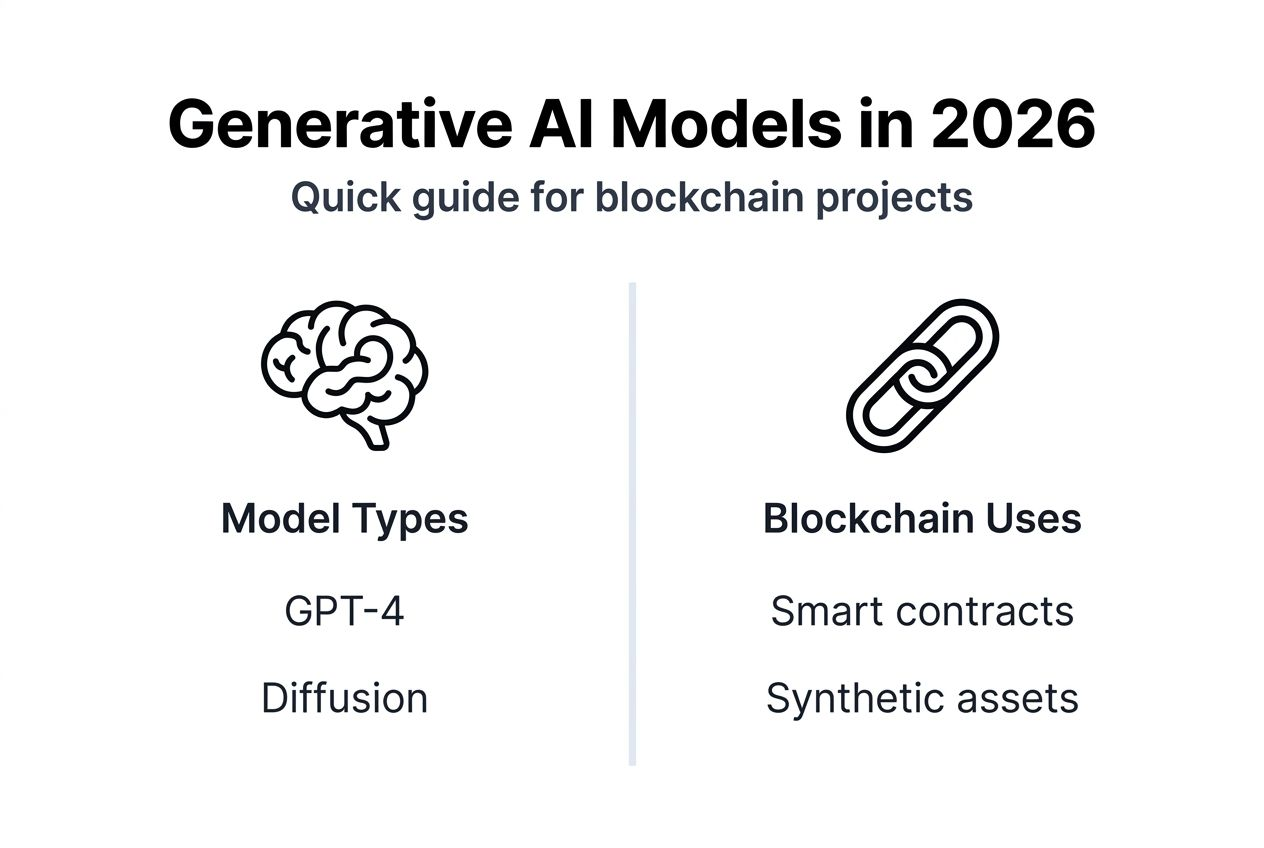
General-purpose large language models like GPT-4 offer impressive breadth. They handle diverse queries across countless topics but lack deep specialization. When applied to regulated industries like finance or healthcare, their outputs require extensive verification because training on internet-scale data introduces inconsistencies.
Domain-specific models sacrifice breadth for precision. A legal AI trained exclusively on case law, statutes, and legal briefs produces more reliable contract analysis than a general model. Financial institutions deploy models trained on market data and regulatory filings rather than using consumer-facing chatbots for trading decisions.
| Model Type | Parameters | Primary Use | Accuracy | Deployment Scale |
|---|---|---|---|---|
| General LLM | 100B+ | Broad tasks | Moderate | Consumer apps |
| Domain-specific | 1-20B | Industry tasks | High | Enterprise |
| Task-focused | 100M-1B | Single function | Very high | Edge devices |
| Multimodal | 10-100B | Cross-format | Variable | Platform services |
Small, task-focused models gain enterprise adoption faster than massive LLMs. A 500-million-parameter model optimized for invoice processing deploys on local servers, protecting sensitive financial data. It runs faster and cheaper than cloud-based general models while delivering superior accuracy for its narrow function.
Agentic AI represents the evolution beyond simple generation. These systems break complex goals into steps, use tools, and iterate toward solutions. An AI agent might research market conditions, generate a trading strategy, execute test trades, analyze results, and refine its approach without human intervention at each step.
Key differentiators when evaluating models:
- Latency: Small models respond in milliseconds; large models may take seconds
- Cost: Task-focused models cost pennies per million tokens; LLMs cost dollars
- Privacy: Local deployment keeps data internal; cloud APIs expose information
- Customization: Domain models fine-tune easily; general models resist specialization
Pro Tip: Match model selection to your specific needs rather than defaulting to the largest or most famous option. A blockchain analytics platform benefits more from a specialized model trained on transaction patterns than from a general-purpose LLM.
The AI market model analysis reveals investment shifting toward companies offering modular, specialized AI solutions. Gaming and blockchain projects leveraging generative AI model trends through purpose-built models demonstrate stronger product-market fit than those pursuing one-size-fits-all approaches.
Watch for agentic AI trends in blockchain applications particularly. Smart contracts that autonomously optimize gas fees or gaming NPCs that genuinely learn from player interactions represent the next investment wave.
Emerging trends and future outlook for generative AI in 2026
Generative AI’s economic impact accelerates dramatically as adoption moves from experimentation to production deployment. AI adoption generates $30-$40 billion revenue globally in 2026, with investment growth showing no signs of slowing.
Business commitment to AI intensifies across sectors. Eighty percent of companies increase their AI budgets in 2026, recognizing competitive disadvantages for late adopters. This investment flows into infrastructure, talent acquisition, and integration projects that embed AI into core business processes.
Synthetic data generation solves critical privacy and scarcity challenges:
- Healthcare AI trains on synthetic patient records that preserve statistical properties without exposing real individuals
- Financial models develop using generated transaction data that mimics market patterns
- Gaming analytics leverage synthetic player behavior data for testing without privacy violations
- Blockchain projects generate test scenarios at scale for stress testing smart contracts
Synthetic data and agentic AI breakthroughs enable compliant innovation in regulated industries where data access traditionally limited AI development.
Agentic AI transforms workflow automation beyond simple task completion. These systems handle multi-step processes that previously required human judgment at decision points. A blockchain auditing agent might scan code, identify vulnerabilities, research similar exploits, generate patches, test fixes, and submit pull requests autonomously.
| Trend | 2026 Impact | Blockchain Application | Gaming Application |
|---|---|---|---|
| Revenue growth | $30-40B market | Smart contract automation platforms | AI-powered game engines |
| Synthetic data | Privacy-safe training | Test transaction generation | Player behavior modeling |
| Agentic AI | Autonomous workflows | Self-optimizing DeFi protocols | Adaptive game directors |
| Domain models | 60% enterprise adoption | Crypto trading specialists | Genre-specific content generators |
The convergence of these trends creates new investment categories. Platforms offering specialized AI infrastructure for blockchain or gaming command premium valuations because they solve industry-specific challenges better than general AI providers.
Edge deployment gains momentum as models shrink without sacrificing capability. Mobile games run sophisticated AI locally rather than requiring cloud connectivity. Blockchain nodes incorporate AI analysis without compromising decentralization.
Watch for companies demonstrating measurable AI-driven efficiency gains rather than those simply implementing AI for competitive positioning. The generative AI economic impact concentrates in organizations that fundamentally redesign processes around AI capabilities rather than bolting AI onto existing workflows.
Explore more with Moltbook News
Staying informed about AI, blockchain, and gaming developments gives you an edge in these fast-moving markets. Moltbook News delivers the analysis you need to spot emerging trends before they become mainstream.
Our coverage connects technical innovations to investment opportunities, helping you understand not just what’s happening but why it matters for your portfolio. From deep dives into new AI models to blockchain project evaluations and gaming industry shifts, we translate complex developments into actionable insights.
Visit Moltbook Nachrichten to access our full library of articles, market analysis, and expert commentary. Whether you’re researching specific projects or tracking broader sector trends, our content keeps you ahead of the curve in AI and cryptocurrency markets.
Frequently asked questions
What is generative AI?
Generative AI refers to artificial intelligence systems that create original content like text, images, code, or video by learning patterns from training data. Unlike traditional AI that classifies or predicts, generative models produce entirely new outputs that didn’t exist in their training sets. These systems use deep learning architectures to understand relationships and generate novel combinations.
How does generative AI differ from traditional AI?
Traditional AI typically performs specific tasks like classification, prediction, or optimization based on predefined rules or patterns. Generative AI creates new content autonomously by learning abstract patterns from data. While traditional AI might identify a cat in a photo, generative AI produces an entirely new cat image that never existed before.
What are the main applications of generative AI in blockchain?
Generative AI powers smart contract automation, reducing development time and security vulnerabilities. It creates unique NFT assets at scale, from artwork to 3D metaverse objects. AI agents enable sophisticated decentralized finance strategies, executing complex trades and managing risk automatically. Over one-third of blockchain projects integrate these capabilities by 2026.
Can small businesses benefit from generative AI?
Absolutely. Task-focused generative AI models cost significantly less than large general-purpose systems while delivering superior results for specific functions. Small game studios use AI to generate content at a fraction of traditional costs. Blockchain startups leverage AI for smart contract development without large engineering teams. The technology democratizes capabilities previously exclusive to major enterprises.
What risks should investors consider with generative AI projects?
Key risks include overpromising on capabilities, inadequate training data quality, insufficient human oversight, and regulatory uncertainty. Projects claiming fully autonomous AI likely underestimate deployment complexity. Evaluate whether teams demonstrate working implementations rather than conceptual roadmaps. Assess data sources, model architectures, and quality control processes before committing capital.
How will generative AI evolve in gaming by 2027?
Expect deeper integration of agentic AI creating truly adaptive experiences where game worlds respond intelligently to player choices. Procedural generation will extend beyond environments to encompass narrative arcs and character development. Voice-driven NPCs with contextual memory will become standard. The line between developer-created and AI-generated content will blur as hybrid approaches dominate.
